1. What is Exax?
Exax is a data processing framework designed to make development and operations faster and with fewer mistakes. Although exax implements several novel ideas, there is one feature that stands out and as will be shown later provides a number of exciting advantages:
Things are computed only once.
Exax remembers all program executions, and can instantly return a previously computed result given input data, parameters, and program source code.
In addition, a naive but simple to use parallell processing environment helps speeding up many practical use cases significantly.
Exax has a small footprint, few dependencies, and can run on any hardware ranging from a Raspberry Pi or laptop to a multi-processor rack server.
For dashboarding and visualisation of results and program/dataflows, exax has an integrated web server.
Read about more features below.
1.1. Simplified Block Diagram
The figure below shows a simplified block diagram, where data flows from left to right (from input directory to result directory), and user interfaces are at the bottom marked in blue colour.
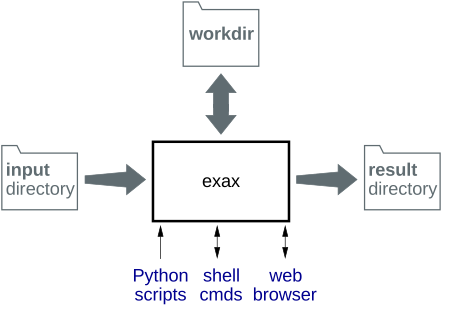
The workdir is a directory where data and meta data relating to executions are stored and retrieved from.
1.2. Design Goals
Exax is designed to be
fast, because
it will re-use earlier computations to save execution time
it is very easy to write simple but very powerful parallel programs
it comes with a very fast streaming data container for large parallel datasets
in a collaborative environment, results are re-used between users
transparent and reproducible, meaning that
it is straightforward to validate that a specific result is the result of a specific run
there is an observable connection between results, source code, and input data
it is easy to inspect any step in the execution/data flow
helpful in avoiding common mistakes, because
there is no need for arbitrary intermediate filenames that can be mixed up
results can be verified to be up to date with source code and input data
minimalistic, because
it has a very small footprint
it has a minimum of dependencies
1.3. Some Key Highlights
Exax remembers old computations, and will not re-compute anything that has been computed before. Computation re-use is a core part of the methodology and “just works”. This saves time and energy.
The simple parallel processing capabilities makes use of modern multi-core processors and speed up computations correspondingly.
The transparent workflow, from input data and source code to computed results, is easy to inspect, and exax will always show results that are up to date with the project’s source code.
Several users can work on the same project on the same machine, and share results and intermediate computations without interfering with eachother.
Exax is originally designed for back end processing of large live running recommender systems. It is therefore easy to operate.
A built in database, called the Urd database, may be used to store and retrieve references to computations and results using simple human readable keys.
The streaming dataset datatype stores typed data in a row-column format suitable for parallel processing. It can handle billions of rows with thousands of columns easily, on a laptop. When accessed, the data is streamed from disk to the CPU cores, thereby avoiding time consuming disk seek operations.